
A Connected, Competitive and Sustainable Megaregion
STRING is a political cooperation of cities and regions across Germany, Denmark, Sweden and Norway. Along the Hamburg–Oslo corridor, we work together to remove cross-border bottlenecks and connect infrastructure, markets, talent and innovation.
Our ambition is to unlock the potential of Northern Europe as a more integrated, resilient and sustainable megaregion. Strong democratic institutions and high levels of societal trust provide a foundation for cooperation that benefits cities and their surrounding regions.
The approved STRING 2026–2030 Strategy brings this ambition together through two mutually reinforcing pillars: Infrastructure & Connectivity and Enhancing Competitiveness. Better connections enable innovation, investment and labour mobility; stronger economic cooperation reinforces the case for the infrastructure our region needs.
Members and the Secretariat advance these priorities through political advocacy, partnerships and cross-border projects, giving the megaregion a shared voice in national and European decision-making.
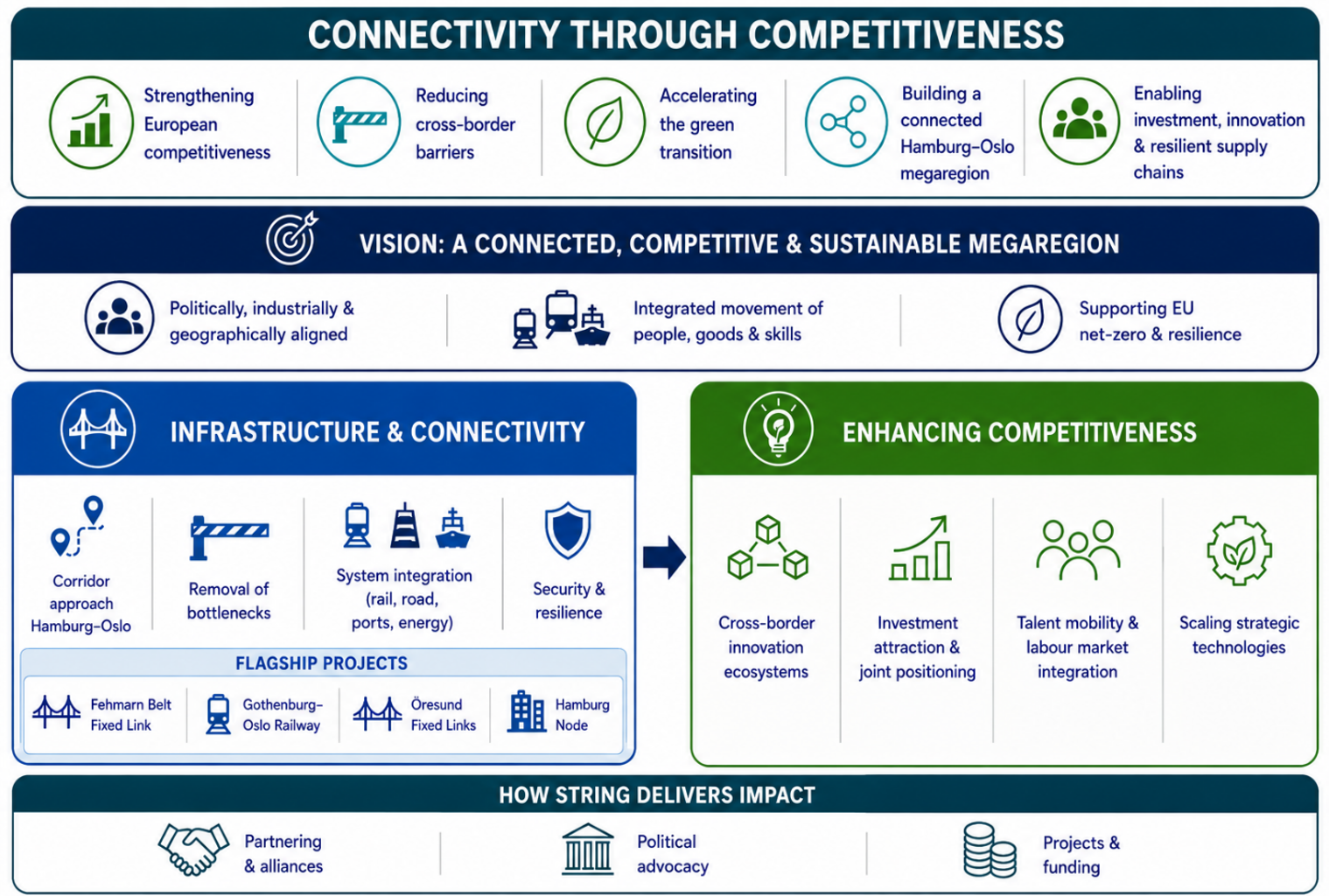
1. Infrastructure & Connectivity
Infrastructure is the backbone of STRING’s cooperation. We work to strengthen the entire Hamburg–Oslo corridor, remove bottlenecks and improve reliable connections for people and goods. Rail, road, ports, charging infrastructure, alternative fuels and energy connections must reinforce one another.
Our work supports a shift from road to rail for passengers and freight, low-emission transport, inclusive mobility and infrastructure that meets both civilian needs and military mobility requirements.
Four shared long-term priorities guide our infrastructure portfolio:
- Fehmarn Belt Fixed Link & Hinterland Connections
- Hamburg Node
- Fixed links across the Öresund Belt
- Gothenburg–Oslo dual-track railway
2. Enhancing Competitiveness
STRING connects sustainable industries, universities, innovation ecosystems and public stakeholders across borders so that businesses and research communities can collaborate, test, commercialise and scale solutions.
Our Green Investment & Innovation Hub agenda links regional strengths and supports cooperation between Investment Promotion Agencies, shared knowledge and joint international positioning. It builds on existing ecosystems and helps them work together at megaregional scale.
Labour-market integration and talent mobility are equally central. STRING works to reduce administrative and technical barriers and strengthen cooperation between employers, education institutions and labour-market actors. Better transport connections and easier movement across borders can improve access to jobs, skills and talent throughout the megaregion.
The Evidence Behind the Cooperation
Kiel Institute: turning connectivity into integration
The Kiel Institute for the World Economy’s 2026 report, Development Perspectives of STRING, finds that STRING has developed dynamically and that stronger connections can benefit both urban centres and less densely populated regions.
The report also makes clear that STRING is still developing as an integrated economic area. Realising the benefits of the Fehmarn Belt Fixed Link requires better connections along the corridor towards Oslo and into surrounding regions, alongside stronger business relations, innovation networks and cross-border labour markets. Infrastructure creates opportunities; sustained cooperation helps people and businesses use them.
Read the Kiel Institute report (2026)
OECD: a continuing foundation
The OECD’s 2021 work on STRING remains an important foundation for the megaregional approach. Its case for sustainable cross-border transport, cooperation on green growth, and a cohesive and inclusive region continues to inform our work.
Connecting cities and regions can expand access to skills, markets and innovation while sharing opportunities more widely. These principles remain relevant within the approved 2026–2030 Strategy, which organises STRING’s current priorities around Infrastructure & Connectivity and Enhancing Competitiveness.