
Connecting the corridor
Infrastructure is the backbone of STRING’s cooperation. Reliable cross-border connections support integrated markets, sustainable growth, labour mobility and resilience across the Hamburg–Oslo corridor.
STRING takes a whole-corridor perspective: rail, road, ports, charging infrastructure, alternative fuels and energy connections must reinforce one another. We support a stronger shift from road to rail for passengers and freight, alongside infrastructure that meets civilian needs and military mobility requirements.
SWECO’s November 2025 rail-freight assessment identifies 15 bottlenecks within and adjacent to the northern Scandinavian–Mediterranean corridor. It reinforces the need to address tracks, terminals and cross-border operations together so that the Fehmarn Belt Fixed Link can deliver its full benefits. Explore the findings and bottleneck map below.
Four shared infrastructure priorities
Fehmarn Belt Fixed Link & Hinterland Connections
STRING works to ensure that the fixed link’s benefits are supported by efficient connecting infrastructure. Capacity and reliable hinterland connections are essential to closer economic and labour-market integration.
Hamburg Node
Hamburg connects Northern and Central Europe and serves passenger, freight and port traffic. Addressing capacity constraints at this node is essential to the performance of the wider corridor.
Fixed links across the Öresund Belt
STRING supports an Öresund metro between Copenhagen and Malmö as a long-term capacity solution and works to advance planning and political support for a Helsingør–Helsingborg tunnel. These proposed links could strengthen mobility, regional cohesion and transport redundancy.
Gothenburg–Oslo dual-track railway
STRING supports upgrading the existing railway to double track, with long-term potential for high-speed rail. Greater capacity and reliability can improve rail’s competitiveness for passengers and freight and strengthen links between Sweden and Norway.
All four initiatives are shared long-term priorities. STRING’s engagement may vary with project maturity, political momentum and opportunities to advance them.
Low-emission transport and energy connections
Charging and alternative fuels as one system
STRING supports low-emission transport infrastructure across the corridor, combining stronger rail connections with charging infrastructure, alternative fuels, ports and energy connections. Hydrogen initiatives remain part of this wider system perspective.
Initiative: The SEALS Project
The SEALS Project contributes to the electrification of logistics, translating cross-border cooperation into practical action for low-emission transport.
Rail capacity and bottleneck removal
More reliable passenger and freight connections
Evidence: 15 rail-freight bottlenecks
SWECO’s Rail Freight with the Fehmarn Belt Fixed Link: Unlocking the Potential (27 November 2025), commissioned by STRING and Greater Copenhagen, assesses 15 capacity constraints within and adjacent to the northern Scandinavian–Mediterranean corridor.
Its central finding is that the Fehmarn Belt Fixed Link’s full benefits depend on improvements across the wider network. Constraints on tracks, terminals, train lengths and signalling affect reliability, journey times, costs and the availability of freight services. Without coordinated action, the opportunity to shift more freight from road to rail risks being missed.
What the analysis means for the corridor
- Connect the whole network. Rail access to the Fehmarn Belt, the Hamburg node and terminals, capacity in southern Sweden and Gothenburg, and the Gothenburg–Oslo connection must work together.
- Make rail easier to operate across borders. Longer freight trains and coordinated deployment of the European Rail Traffic Management System (ERTMS) can strengthen capacity, efficiency and interoperability.
- Coordinate planning and delivery. SWECO calls for stronger cross-border political dialogue, faster planning and consideration of more effective implementation and financing methods.
- Strengthen resilience across transport modes. Rail, ports, maritime alternatives and low-emission road transport form a connected system, supporting reliable supply chains and civilian and military mobility.
The bottlenecks on the map
The map below is reproduced from Figure 2 on page 13 of SWECO’s report. Click the image to view it at full size. Its colours reflect the November 2025 assessment, which used the original 2029 Fehmarn Belt opening benchmark. They should be read with that date and scope in mind.
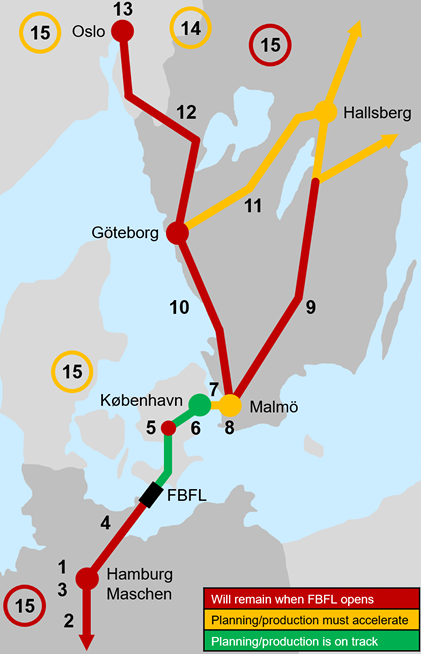
Source: SWECO, Rail Freight with the Fehmarn Belt Fixed Link: Unlocking the Potential, 27 November 2025, Figure 2, p. 13. Commissioned by STRING and Greater Copenhagen.
Map key: the 15 bottlenecks
- Railway node Hamburg
- Hamburg–Hannover railway
- Hamburg terminal capacity
- Hamburg–Lübeck–Puttgarden–Fehmarn Belt rail connection
- Terminal availability and prices in Denmark
- Danish bottlenecks around Copenhagen
- Strategic redundancy across the Öresund
- Swedish bottlenecks around Malmö
- Southern Main Line in Sweden
- West Coast Line around Gothenburg
- Western Main Line in Sweden
- Oslo–Gothenburg railway
- Oslo-region railway system and Alnabru terminal
- Train lengths in Sweden and Norway
- European Rail Traffic Management System (ERTMS)
From evidence to STRING’s 2026–2030 ambitions
The approved strategy commits STRING to monitor infrastructure bottlenecks annually, building on SWECO’s analysis, and to support members in maintaining political attention at national and European levels. The four flagship priorities remain the Fehmarn Belt Fixed Link and its hinterland connections, the Hamburg node, fixed links across the Öresund Belt, and the Gothenburg–Oslo dual-track railway.
STRING’s agenda covers both freight and passengers. Alongside the rail-freight issues assessed by SWECO, the strategy highlights passenger capacity on the Maria–Helsingborg section of the West Coast Line, faster rail services, inclusive mobility, low-emission infrastructure and cooperation to secure EU funding for regional investments.
By connecting bottleneck removal with labour mobility, integrated markets and reliable supply chains, infrastructure supports the strategy’s wider ambitions for competitiveness, sustainable growth and resilience.
SWECO’s recommendations are the consultancy’s analysis and do not necessarily represent the positions of STRING, Greater Copenhagen or their members. STRING’s commitments are set out in the approved 2026–2030 Strategy.
Fixed links and regional integration
Capacity, reliable connections and shared benefits
Fixed links can strengthen cross-border mobility and connect communities, businesses and labour markets. Their benefits depend on sufficient capacity and reliable connecting infrastructure on both sides of a crossing.
STRING’s strategic portfolio includes the Fehmarn Belt Fixed Link and its hinterland connections, alongside proposed additional crossings across the Öresund Belt. We work to advance planning and political support, with attention to sustainable mobility and resilience.